

AI behavior reports and the IEP
— how a session becomes evidence
While a child plays on the interactive whiteboard, Avatar Coach compiles the observation record into documents a teacher can attach to IEP present levels. This page explains that process and — more importantly — the lines the AI is built not to cross.
The AI safeguards, first
Report and draft text is written by a large language model, but what it may and may not say is decided by code, not by the prompt alone. This section comes first because it is the question teachers ask first.
Real names never reach the AI
A student's real name is substituted before any request is sent to the model, and restored only in the finished document. Substitution runs in two layers — at aggregation and again immediately before the request — and it also scans free-text a teacher typed. This behavior is pinned by regression tests.
No goal without a measurement to cite
Every goal in a draft must cite an actual measured value. Where there is no measurement to cite, the model is instructed not to invent the goal at all. A developmental area with no observation data gets "no observation data — teacher assessment required" instead of a plausible sentence.
Things it is instructed never to produce
- Assignment or hours of related services such as speech, physical, or occupational therapy
- Prescriptive claims that a specific intervention technique should be used
- Re-diagnosis of a disability or any judgement about medical cause
- Presenting a prompted success as independent performance, or asserting a trend from a small sample
Accountability is printed on the document
The notice that goals and related services are determined by the individualized education support team is appended by code even if the model omits it. A teacher can edit a draft and save it as a new revision; the original is never overwritten.
Three outputs, with different standing
| Output | What it is | Does it write goals? |
|---|---|---|
| Session record | An automatic summary at the end of each round — activity, level, success rate, duration, and one line of measured indicators | No |
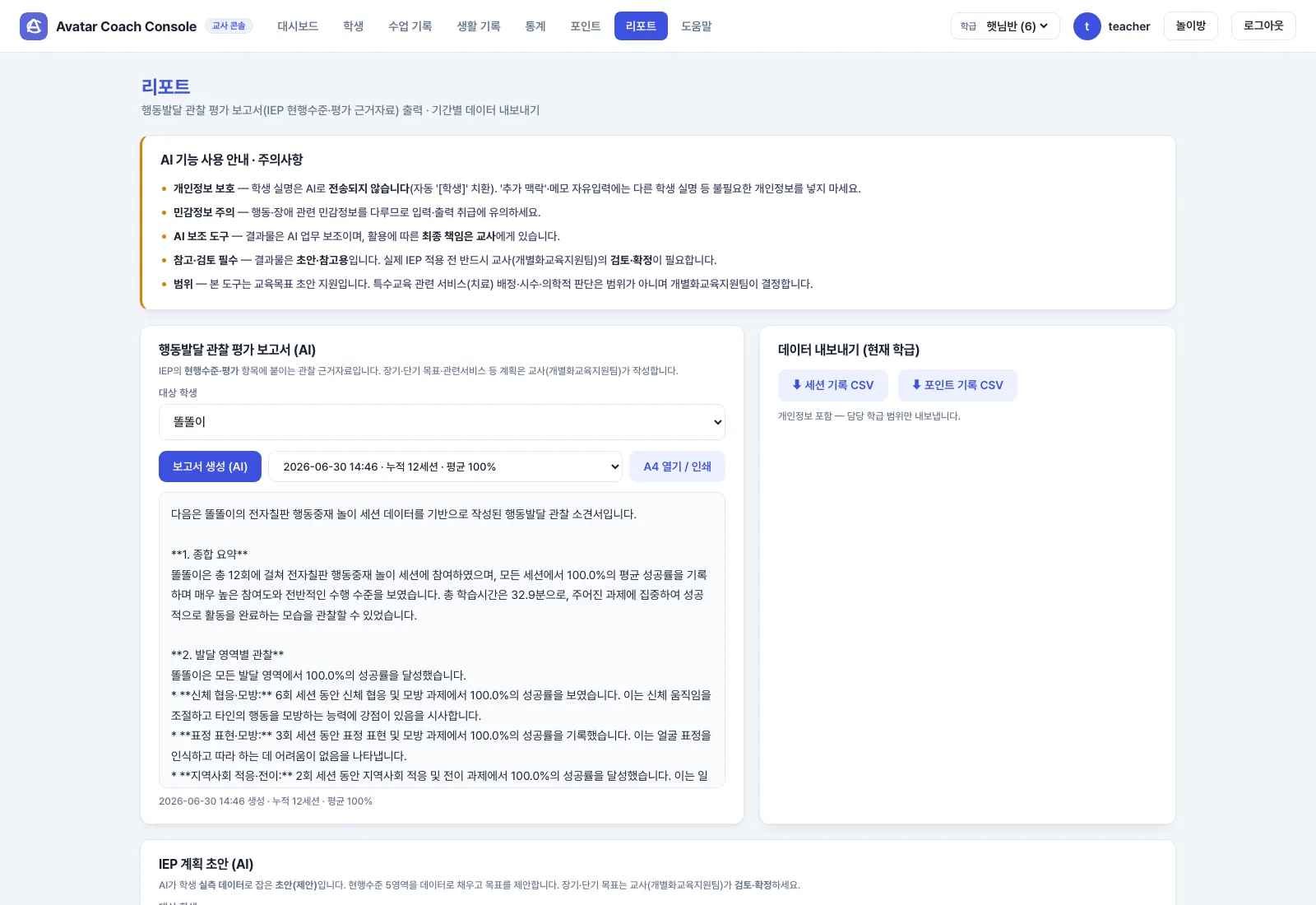
| Behavior observation report | Accumulated records organized by developmental area. This is evidence, attached to the present-levels and evaluation sections of the IEP | No — deliberately not |
| Draft IEP plan | Present levels across five areas (cognitive, communication, social-emotional, physical-motor, adaptive behavior) with proposed long- and short-term goals | Proposals only — every goal is marked "proposed value, teacher confirmation required" |
The observation report not writing goals is a design decision, not a missing feature. Setting goals is the authority of the individualized education support team; the tool's role ends at the evidence that decision rests on. This principle is printed as a notice at the foot of every report. A one-page meeting handout — target behaviors, current independent correct response rate, and the checklist — can also be printed.
From session to report — five steps
- Round ends
The child finishes a behavior intervention activity on the whiteboard.
- Session saved
Activity, level, success rate, and duration are stored automatically.
- Trial-level records
For every trial within the round: success or not, the type and number of prompts, response time, and the replacement behavior practised.
- Generated in the console
The teacher generates the report or draft with one button. Revisions accumulate, so it can be compared against earlier ones.
- Printed and signed
Reports print on an A4 form with signature lines for the teacher and the head of special education. The signature line is the point — the author and the responsible party are people.
What gets recorded
- Session indicators — activity name, level, success rate, duration
- Trial indicators — success per trial, type and number of prompts, response time after the instruction, replacement behavior practised
- Performance by developmental area — performance is grouped by the areas an activity addresses. Areas without data are left empty
- Records from outside the activities — behavior incidents a teacher logged directly are included once reviewed
Only successes with no prompt recorded count as independent. It has a different denominator from overall success rate, so the two are printed separately. Support given away from the screen is not recorded, which makes this a record-based computation rather than a complete measure — and the report says so.
Frequently asked questions
No. The observation report is evidence attached to the present-levels and evaluation sections of the IEP, and the draft plan is a starting point for team discussion. The IEP is authored by the individualized education support team.
It proposes, and stops there. Every goal in a draft carries "proposed value, teacher confirmation required," and only what a teacher edits and confirms becomes a document.
No. Names are substituted before the request, so real names are never transmitted, and accounts outside the class cannot reach the reports.
New to the concepts behind behavior intervention — PBIS, function, replacement behavior, prompting? Start with the behavior intervention guide.